
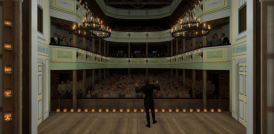
Credits: VR model of the 1841 Queen’s Theatre in Adelaide, South Australia, with avatar spectators and an avatar performance by Gerrard McArthur as Gustavus Arabin, as seen from upstage. Modelling by Ortelia. See losttheatres.net for more.
Biographie
Professor Emerita Joanne Tompkins (University of Queensland, Australia) has published on post-colonial theatre, intercultural theatre, and many different explorations of space and spatiality in theatre. Most recently she has led a project that reconstructs lost theatres through virtual reality:
Visualising Lost Theatres (with Julie Holledge, Jonathan Bollen and Liyang Xia) and the website losttheatres.net. She is one of the founders of
AusStage, a digital resource for Australian performance information. She is a Fellow of Australia’s Academy of Humanities and recipient of an honorary doctorate from Queen Mary University of London. She is an executive committee member for the International Federation for Theatre Research and co-editor of IFTR’s new book series (with Bloomsbury). From 2017 to 2020, she was seconded to the Australian Research Council as Executive Director for Humanities and Creative Arts.
Présentation de l'intervention
This seminar reflects on what we’ve learned about theatre and about digital humanities from the research that resulted invisualising Lost Theatres
(authored by me, Julie Holledge, Jonathan Bollen, and Liyang Xia, Cambridge 2022), which examined five theatres that no longer exist. We constructed VR models of these venues, based on as detailed historical information as we could find, and were able to discuss more about theatre history in these moments than we believe would otherwise be possible. I consider what has been gained, what the limitations might be, and what kinds of work this project facilitates for future into theatre history that is assisted by digital humanities methodologies such as virtual reality.