
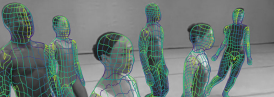
Credits: “Dunham Technique: Dunham walk—slow” (2023). Video. https://loc.gov/item/ihas.200003863; Nicola Plant for Visceral Histories, Visual Arguments: Dance-Based Approaches to Data.
Biographie
Kate Elswit is Professor of Performance and Technology and Head of Digital Research at the Royal Central School of Speech and Drama, where she is also Co-Director of the Centre for Performance, Technology, and Equity (PTEQ). For the past decade, she has been collaborating with Harmony Bench to bring dance and experimental digital practice into conversation, including through the AHRC-funded projects Visceral Histories, Visual Arguments: Dance-Based Approaches to Data (2022-25) and Dunham’s Data: Katherine Dunham and Digital Methods for Dance Historical Inquiry (2018-22). As Moving Data, their dance data commission from the Whitney Museum of American Art recently appeared in the Edges of Ailey exhibition (2024-25).
Présentation de l'intervention
This talk draws on a decade of projects led by Kate Elswit and Harmony Bench to build dialogues between dance historical research and emerging technologies, most recently a dance data commission from the Whitney Museum of American Art. We began by asking: what are the questions and problems that make the curation, analysis, and visualization of data meaningful for dance historical analysis? In the process, we discovered that we also needed to be asking the reverse: what might digital methods learn from dance, in particular with respect to bodies and data? How might dance-based knowledge practices help to develop new ways of approaching data as a humanistic concern? I introduce our practices of radical accounting, visceral data analysis, and kinesthetic attunement through the manual curation of datasets from print archives, before turning how those practices translated (and did not) as we began to add computer vision and motion capture. Across these examples, I explore how research into historical embodiment can be extended through a data frame, without being limited to what data alone can reveal or represent, and conclude by proposing an expanded register of motion data that is both individual and collective, shared across generations through deep bodily time.